
Why Mid-Market Leaders Must Never Stop Learning: The Total Leader® Perspective
09/21/2026
by
Jim Crisafulli
When a company crosses the 70-employee threshold, the rules of leadership change overnight. You are no longer managing a tight-knit startup through sheer willpower and daily face-to-face contact. At this stage, your business has transitioned into a complex ecosystem with multiple tiers of management, diverse department silos, and decentralized communication lines.
For mid-market business owners and executives, the most dangerous trap is believing that the skills that got you to 70 employees are the same ones that will take you to 200.
Leadership at scale is not a fixed destination; it is an ongoing process of evolution. The moment an executive stops learning, the organization’s growth curve flattens. To successfully navigate this organizational inflection point, leaders can look to the Total Leader® Concept, a flagship framework developed by Leadership Management International (LMI). This philosophy demonstrates that scaling a business sustainably requires continuous learning across four critical dimensions.
The Four Dimensions of Scaling Through Learning
According to LMI’s framework, managing a large-scale organization requires mastering four specific areas. Here is how a mid-market leader must continuously use learning to steer each facet:
1. Learning to Transition from Doing to Delegating: Effective Personal Productivity
In a 70+ person company, a leader’s biggest bottleneck is often their own calendar. If you are still handling routine operational decisions, you are holding the company back.
- The Scaling Reality: Leaders must continuously learn how to guard their time. This means analyzing workflows, mastering advanced delegation, and using productivity frameworks to focus exclusively on high-payoff strategic activities. You must learn to work on the business, not in it.
2. Learning to Lead by Culture, Not Control: Effective Personal Leadership
When you have dozens of employees, you can no longer personally oversee every project. Your influence must be felt through your character, your emotional intelligence (EQ), and the culture you project.
- The Scaling Reality: Command-and-control leadership fails at scale. True Total Leaders constantly seek feedback to identify their blind spots. They learn how to model the exact accountability, vulnerability, and transparency they want their mid-level managers to mirror.
3. Learning to Develop a Leadership Pipeline: Effective Motivational Leadership
With over 70 employees, your direct impact on the frontline staff is diluted. Your success now depends entirely on the capability of your managers and supervisors.
- The Scaling Reality: You are no longer just leading employees; you are leading leaders. Executives must continuously learn coaching frameworks to shift from answers-driven bosses to growth-driven mentors. You must learn what uniquely motivates your management tier so they, in turn, can inspire the frontline.
4. Learning to Navigate Market Complexity: Effective Strategic Leadership
A larger workforce means higher overhead and greater risk. You cannot afford to make strategic decisions based on gut feeling alone.
- The Scaling Reality: Complacency at this scale kills organizations. Strategic leadership requires an ongoing commitment to studying market trends, analyzing operational data, and refining the corporate vision. Leaders must continuously learn how to align their organizational structure with long-term goals to stay agile.
Balancing the “Total Person” at Scale
Running a mid-sized company comes with intense pressure that easily triggers executive burnout. LMI’s approach recognizes that business performance is directly tied to personal well-being. Through the LMI Total Person® Approach, leaders are taught to pursue goal-oriented learning across six areas of life to maintain equilibrium:
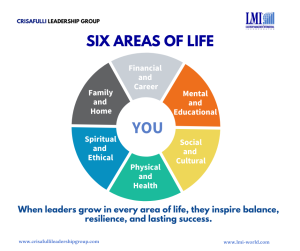
- Financial & Career: Learning sophisticated capital allocation, risk management, and scaling strategies.
- Physical & Health: Learning the stress-management and nutrition habits required to sustain high-energy executive stamina.
- Family & Home: Learning how to decouple from work and show up intentionally for your family despite a demanding schedule.
- Social & Cultural: Learning how to leverage your company’s growing influence to impact your community positively.
- Mental & Educational: Keeping your mind sharp by reading outside your industry and challenging established assumptions.
- Spiritual & Ethical: Learning to ground your corporate governance in a strong, unchanging ethical framework.
When an executive stops learning and growing in their personal life, the resulting strain eventually bleeds into corporate decision-making.
The Growth Subscription
At 70+ employees, your organization is too big for accidental success and too small to survive rigid bureaucracy. The titles and equity you hold are simply tools; your real leverage is your capacity to grow.
By applying LMI’s Total Leader concept, you recognize that the rent on leadership is due every day. Never stop evaluating your productivity, never stop building your managers, and never stop scanning the horizon. Keep growing, keep evolving, and never stop learning.
Written By

Jim Crisafulli